
The Coachella Valley packs more than 100 golf courses into a stretch of desert roughly 45 miles long, and almost all of them are built on the same fundamental compromise: warm-season bermudagrass that thrives in brutal summer heat but goes dormant and brown when night temperatures drop. To keep fairways green through the winter high season, most courses overseed with ryegrass in the fall, which means shutting down or severely restricting play for a few weeks. That single agronomic fact does more to determine the best time to golf in Palm Springs than temperature ever will.
Everything else follows from the calendar. Rates in the desert swing wildly, sometimes by a factor of four or five between a January morning and a July afternoon at the same course. Conditions swing just as hard. Knowing which month buys you what, and booking accordingly, separates a trip that feels like a bargain from one that feels like a tax.
Peak season: January through April
This is the desert at full strength. Daytime highs typically sit in the 70s and low 80s, the overseeded rye is fully grown in and holding color, and the valley runs at capacity. Every course is open, every tee sheet is full, and the resort corridors from Palm Springs down through Indian Wells and La Quinta stay busy from breakfast through happy hour.
You pay for it. Peak-season green fees at the marquee resort courses run several hundred dollars in the mornings, and even the mid-tier municipal and daily-fee tracks command their highest numbers of the year. Twilight rates exist and are meaningfully cheaper, but in January and February the sun sets early enough that a twilight tee time can leave you finishing 16 holes instead of 18. Confirm the twilight cutoff and the posted sunset before you book one.
Two calendar items reshape availability. The PGA Tour's American Express tournament runs in January at PGA West and its neighboring courses in La Quinta, and the host layouts close to public play around it. The valley also fills for the music festivals in April, which drives up hotel rates without doing much to golf demand, so April can actually be one of the better value pockets inside peak season if you find lodging outside Indio.
How far ahead to book
For January through March, book tee times as soon as the course opens its window, commonly 60 to 90 days out for resort properties and shorter for municipals. Popular morning slots at the well-known courses genuinely disappear. If you are traveling with a group of eight or more, contact the golf shop directly rather than working through a booking engine. Groups often get blocked times that never appear online.
The pleasant shoulder: November and December
Once overseed grow-in finishes, usually somewhere in the back half of November depending on the course, the desert enters its most underrated stretch. The rye is new and lush, daytime temperatures are mild, the crowds have not fully arrived, and rates sit noticeably below their January peak. Late November through mid-December is, on a pure value-per-condition basis, arguably the best window of the year.
The caveats are real. Mornings can be genuinely cold by desert standards, with frost delays possible on the valley floor in December, and the days are short. Plan to warm up nearby rather than arriving at the first tee cold, and build slack into afternoon plans in case a frost delay pushes your group back an hour. The week between Christmas and New Year's breaks the value math entirely: rates jump to peak levels and tee sheets fill like it's February.
Booking here is more forgiving. Thirty days out is usually sufficient for good morning times, and last-minute availability is common midweek. Call the pro shop and ask a direct question: when did you overseed, and how is the grow-in? Superintendents and shop staff will tell you honestly, and the answer varies course to course by two or three weeks.
The first month to avoid: early October
October looks perfect on paper. Highs drop out of the triple digits, the light softens, and rates are still low. It is also the single worst month to arrive without doing homework, because overseeding is in full swing across the valley. Courses close for stretches. The ones that stay open often keep carts on paths only, restrict access to newly seeded fairways, and run heavy irrigation cycles that leave the property soft and soggy.
Local reporting on the desert's overseed calendar has laid out the practical reality for travelers: the timing varies by course, and the only reliable way to plan around it is to ask each property directly. Golf media covering desert destinations has made the same point more bluntly, noting that fall is not automatically the right time to book a desert golf trip precisely because of overseeding. The Desert Sun's guide to playing through overseeding season covers how valley courses stagger their closures.
If your dates are locked into October, three moves protect the trip. Call every course on your list and get the specific closure dates in writing or by email. Prioritize courses that have already completed their seeding, since a property that closed in mid-September may be in decent shape by mid-October. And accept cart-path-only as the likely condition, which changes how you pack and how long a round takes.
What cart-path-only actually costs you
Path-only golf in the desert is not a minor inconvenience. Desert layouts often have wide corridors of native terrain between the path and the fairway, so every shot involves a real walk with an armful of clubs. Rounds run long. Carry three or four clubs to your ball rather than guessing with one, wear shoes you can walk five miles in, and build an extra 45 minutes into your day. If you are traveling with a player who has mobility limitations, October in the desert is the wrong month, full stop.
The second month to avoid: the peak of summer
July and August in the Coachella Valley routinely run well above 110 degrees. Avoid this stretch unless the discount is the entire point of your trip. Summer is genuine value season. Green fees at courses that command hundreds in January can drop to a fraction of that, and unlimited-replay and stay-and-play packages appear at properties that never discount in winter.
For heat-tolerant players, the math works. The bermudagrass is in its element, so playing surfaces are often excellent, and courses run close to empty. The playbook is narrow but effective: take the first or second tee time of the day, be finished by 10 a.m., and treat any afternoon round as optional. Drink water before you are thirsty, use the on-course misters and coolers, and understand that heat exhaustion in the desert arrives faster than most visitors expect.
Some courses in the valley close entirely for part of the summer for maintenance or reduce operations to a handful of morning hours. Confirm operating status before you build an itinerary. Late summer also brings monsoon activity, which can produce brief but intense storms and occasional course closures from flooding in the washes.
Matching the month to the trip
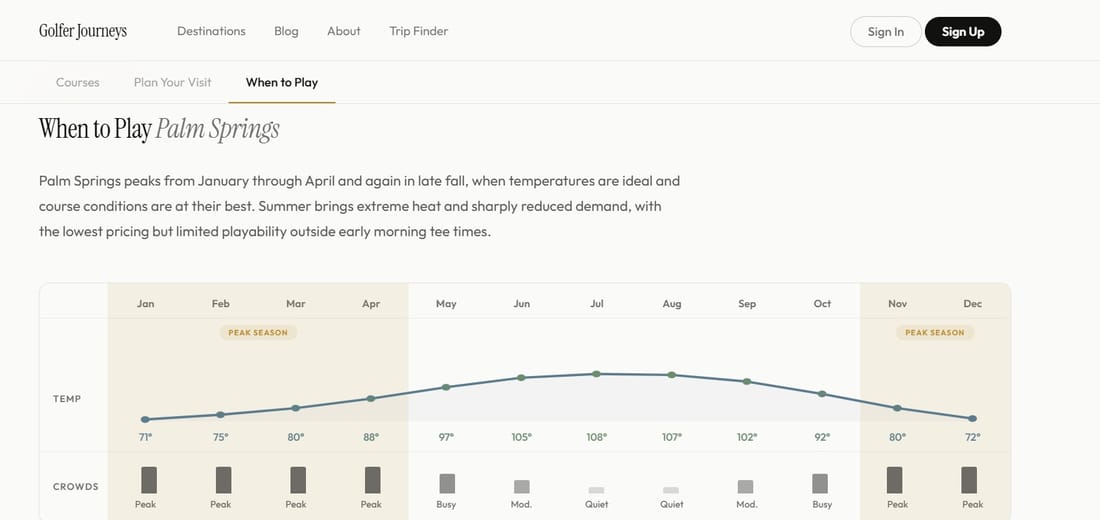
The decision comes down to what you are optimizing for. If conditions and atmosphere matter most and budget is secondary, target February and March and book 90 days out. If you want nearly the same conditions for less, aim for the first three weeks of December after grow-in, and confirm each course's overseed timing before you commit. If price is the only variable that matters and you handle heat well, June through August will hand you courses you could not otherwise afford, on the condition that you are done playing before mid-morning. Before you lock dates, put the whole calendar in front of you. Our Palm Springs destination page charts average high temperature and crowd level month by month, so you can see exactly where your window sits between the 71-degree January crush and the 108-degree July emptiness. Course cards on the same page carry posted fee ranges, which is the fastest way to see how much room a given track has between its summer floor and its February number.
One more piece of desert-specific advice worth internalizing: the ball flies noticeably farther in dry desert air at elevation-adjusted conditions, and the greens on most valley courses run firmer and faster than what most visitors play at home. Give yourself a range session on arrival day before your first tee time to recalibrate distances. If you are building toward the trip, the structure in this 30-day plan for improving your golf game is a reasonable framework for the weeks beforehand. Most golfers who leave the desert frustrated were not beaten by the courses. They were beaten by three-putting from 25 feet on greens they never learned to read.