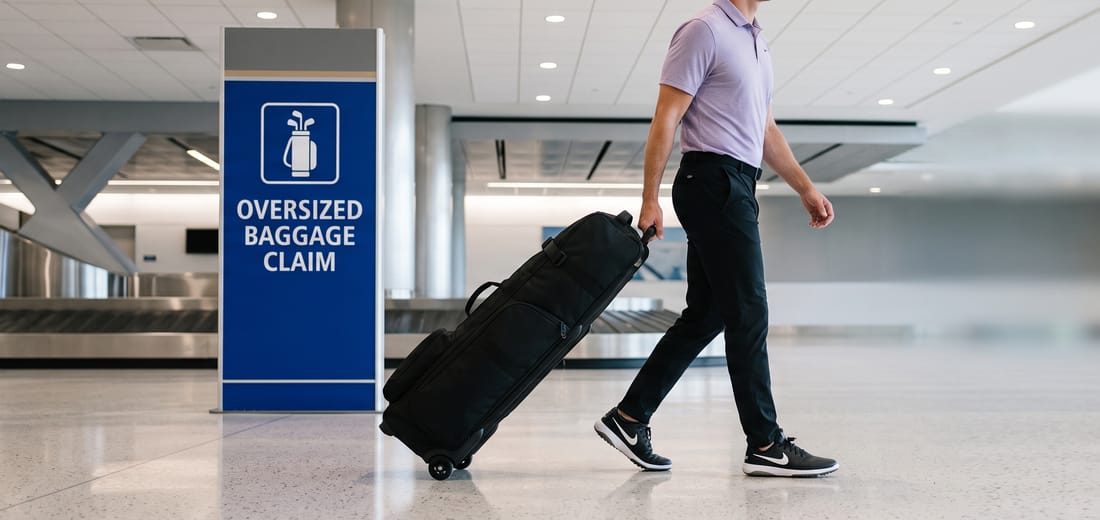

Many U.S. airlines now treat a golf bag as an ordinary checked bag: no surcharge, no oversize penalty, just the standard first- or second-bag fee, provided the packed case stays under the weight limit. That single policy shift is the reason the ship golf clubs vs check golf clubs cost comparison is closer than it was a decade ago, and it is also the reason so many golfers still get the decision wrong. Shipping is no longer the obvious answer for every trip. Checking is no longer the obvious answer for the budget-conscious.
The honest framing is that these two options are not competing on the same axis. Checking usually competes on price. Shipping competes on certainty, handling, and what happens to your week if something goes wrong. Once you decide which of those you are actually buying, the choice usually makes itself in about ninety seconds.
What each option actually costs
Airline baggage fees vary by carrier, route, fare class, and status, and they change often enough that any figure printed today has a shelf life. Ship Sticks maintains a running breakdown of airline golf club fees by carrier that is worth checking against your specific ticket before you commit. As a planning number, a checked golf bag on a domestic U.S. itinerary typically runs in the range of a standard checked-bag fee each direction, and it is frequently waived outright if you hold co-branded credit card status or are flying on a fare that includes bags. Overweight charges are where checking gets expensive: exceed the carrier's limit and the penalty can approach or exceed the base fee itself.
Shipping, typically, will be a bigger, more predictable number. Door-to-door club shipping within the continental U.S. typically lands in the range of $60 to $110 per bag each way for standard ground service, with expedited and long-haul routes climbing higher and Hawaii, Alaska, and international destinations climbing considerably higher. Those are typical ranges, not quotes. The actual price depends on distance, transit speed, declared value, and whether you are shipping to a resort or a residence.
Run the round trip and the gap is usually real but not enormous. For two golfers on a domestic trip, shipping often costs somewhere in the neighborhood of a decent round of golf more than checking. That is the number to hold in your head. The question is whether the difference buys you something.
The hidden line items in checking
The sticker price on checked baggage is not the full cost. You are also paying in curb time, in the physical work of moving a 45-pound case through a terminal and into a rental car, and in the risk that the bag and the golfer arrive on different days. None of that shows up on the fare breakdown, and all of it is real on a four-day trip with a morning tee time the day you land.
Connection risk is the variable that decides it
A nonstop flight is the strongest argument for checking your clubs. The bag goes on one aircraft, comes off one aircraft, and the number of opportunities for it to be misrouted is close to the minimum. On a nonstop domestic itinerary with a reasonable weight-managed case, checking is the correct financial call for most golfers most of the time.
Add a connection and the math changes. Every transfer is another handoff, and tight connections in particular are where oversized items get left behind, because ground crews load standard bags first when they are short on time. A missed bag on a five-day trip is not just an inconvenience. It costs you a round outright, or leaves you stuck a day in rental clubs that do not match your gapping.
Two other route profiles push hard toward shipping: any itinerary with a separate-ticket connection, where no single carrier owns your bag end to end, and any trip where the first tee time is within a few hours of landing. If a delayed bag would cost you an actual round, ship.
Insurance, liability, and what you can recover
This is where golf club shipping insurance and checked baggage protection genuinely differ, and it is the least understood part of the decision. Airline liability for lost or damaged checked baggage on a domestic U.S. flight is capped at a maximum set by the Department of Transportation, and the airline's obligation is to the value of the contents, which you will need to document. Recovering that maximum on a bag of used clubs, with depreciation applied, is not a fast or pleasant process.
More important: many carriers explicitly limit or disclaim liability for damage to sporting goods and fragile items, particularly when they are carried in a soft case. If a shaft snaps inside a soft travel bag, you may have no meaningful claim at all.
Club shipping services generally include a declared-value coverage amount in the base rate and sell additional coverage above that, with a claims process built specifically around golf equipment. You are buying a clearer path to being made whole, not just a bigger number. Either way, the physical protection you provide matters more than the paperwork, and a hard case with a stiff arm and properly padded heads is the single best investment in protecting your gear on a golf getaway.
Lead times and the logistics you have to get right
Shipping only works if you respect the calendar. Standard ground service to a domestic destination generally wants five to seven business days of transit, and the operating rule among experienced travelers is to have clubs arrive two full days before you do. That builds in a buffer for weather, weekend gaps, and a resort bell desk that logs the delivery slowly.
The receiving end needs to be arranged, not assumed. Confirm with the resort or course that they accept and store inbound golf shipments, get the correct receiving address, and put your name, arrival date, and reservation or tee time on the label. Private clubs and public courses without a bag room are the usual failure points. A short email to the golf shop before you book solves it.
Return shipping is the step people forget. Print the outbound and return labels at home, keep the return label inside the case, and confirm before you leave that your final property will hand the case back to a carrier. AFAR's overview of how luggage shipping services work is a useful primer on the mechanics if you have never used one.
Group vans and rental car trunk math
Ground transportation is the argument nobody weighs until they are standing in a parking garage. A hard-shell golf travel case is roughly the footprint of a person lying down, and it does not compress. This is where renting a car with golf clubs stops being a detail and becomes the trip's central logistics problem.
Practical capacity, assuming hard cases and one suitcase per golfer:
- Standard midsize sedan: two hard cases in the trunk with the rear seats folded, and only if the pass-through is generous. Two golfers, maximum.
- Full-size SUV: generally three to four hard cases with the third row down, plus suitcases in the cabin. This is the workhorse for a foursome.
- Minivan with seats removed or folded flat: four cases comfortably and the best value per golfer of any category.
- Twelve-passenger van for a group of eight: the seats are already there, which means the cases are not. Groups this size almost always need a second vehicle or a luggage trailer.
Shipping resolves all of it. Clubs go to the property, you rent a smaller vehicle, and eight golfers fit in one van with carry-ons. For groups of six or more, the reduction in vehicle class often erases most of the shipping premium outright, which is why buddies trips to high-volume destinations tend to convert to shipping after the first year. Anyone who has run the Myrtle Beach buddies-trip gauntlet with four foursomes has watched this play out in a hotel parking lot.
Common mistakes that cost real money
Four errors account for most of the regret in this decision.
- Ignoring the weight limit. A hard case, 14 clubs, shoes, and a dozen sleeves of balls will approach the carrier's checked limit fast. Weigh the packed case at home. Shoes and outerwear belong in your suitcase.
- Shipping to a course that does not receive shipments. Call the golf shop, not the front desk, and get a name.
- Booking ground service four days out. Expedited shipping erases the cost advantage of shipping over checking and then some. If you are inside the window, check the bag.
- Using a soft case to save on weight. The weight saved is a few pounds; the exposure is the club that matters most to you. A stiff arm device that extends above your longest club takes the crush load off the shafts.
The rule of thumb by trip type
Check your clubs when you are flying nonstop, traveling as a pair or a threesome, renting an SUV or larger, and landing at least a half-day before your first tee time. That covers a large share of domestic golf travel, and paying to ship on that itinerary is buying insurance against a risk you have already minimized.
Ship your clubs when your itinerary has a connection, when you are traveling with six or more players, when the destination is Hawaii, an island, or overseas, when you are playing the day you land, or when the clubs in the bag would cost four figures to replace. Book at least seven business days out, confirm the receiving address with the golf shop, and put the return label in the case before you close it. The golfers who never think about this again are the ones who ship on connecting itineraries and check on nonstops, and who decided which one they were on before they bought the plane ticket.