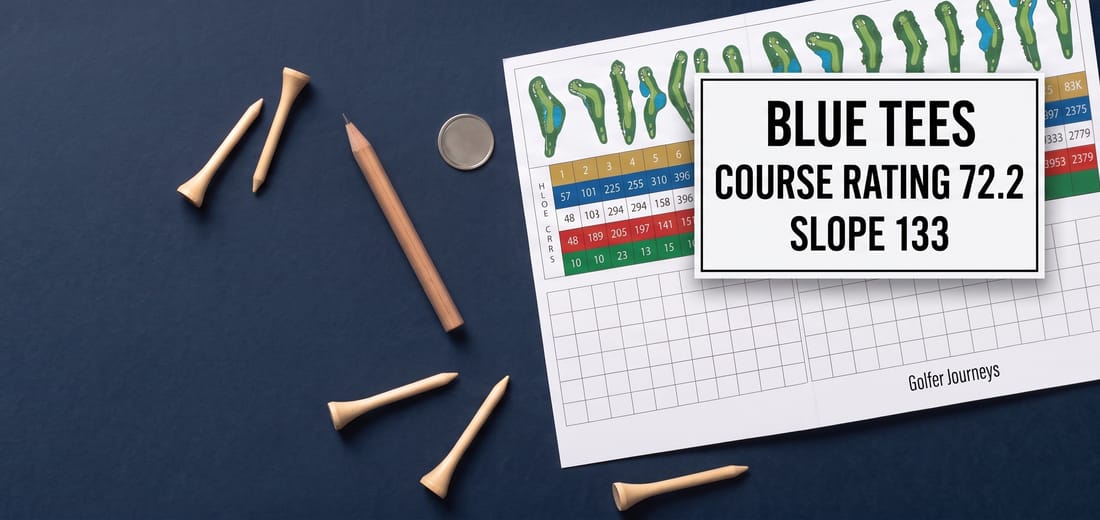

Every scorecard in the United States carries two numbers under each set of tees, printed small enough that most golfers scroll past them on the way to the yardage. One usually looks like 72.4. The other looks like 131. Those are course rating and slope rating, and they are the only pieces of information on the card that tell you how hard the golf course actually plays.
The short version of what do course rating and slope mean: course rating is the score a scratch golfer is expected to shoot from that set of tees, and slope rating measures how much harder the course plays for a bogey golfer than for that scratch player. They answer two different questions. Total yardage answers neither of them well.
Course rating: the expected scratch score
Course rating is expressed to one decimal place and reads like a score, because it essentially is one. A course rating of 72.4 from the back tees means a scratch golfer, playing that set of tees under normal conditions, is expected to average around 72.4 on their better days. It is not the average of every round a scratch player would ever post. It reflects good scoring rounds, not their worst afternoons.
The number is deliberately independent of par. A par 72 can carry a rating of 75.1 or 69.8, and both are common. When the rating sits well above par, the course is genuinely long or demanding for elite play. When it sits below par, the holes are short enough that a scratch player expects to go under. Par is a convention set by the club. Course rating is a measurement.
That measurement comes from trained rating teams who walk the property and evaluate effective playing length alongside a list of obstacle factors: topography, fairway width, rough and recovery, out of bounds, water hazards, bunkers, trees, green surface, and green target size. The USGA's course rating and slope rating documentation lays out how those inputs feed the system. The practical upshot: a 6,400-yard course routed through mature trees with small, firm greens can rate higher than a wide-open 6,900-yard layout.
Why yardage keeps lying to you
Golfers compare courses by total yardage because it is the easiest number to find. It is also the least informative one. Effective playing length accounts for elevation change, prevailing wind, forced layups, and roll. A downhill 6,700-yard course at altitude may play measurably shorter than the card claims, while a wet, tree-lined 6,300-yard track plays longer.
If you are choosing between two courses on a trip and one is 300 yards longer on paper, that gap tells you almost nothing on its own. Compare the ratings instead. The difference between a 71.2 and a 74.6 is a real difference in how the golf course will treat you.
Slope rating: the spread between scratch and bogey
Slope is the number most often misread. It is a two- or three-digit figure with no decimal, and it does not measure absolute difficulty. It measures the gap in difficulty between a scratch golfer and a bogey golfer on the same set of tees.
A bogey golfer, in the system's terms, is a player with roughly a 20 handicap for men and 24 for women. Rating teams produce a bogey rating alongside the scratch course rating. Slope reflects how far apart those two expectations sit. When a course punishes the bogey player far more than the scratch player, the slope goes up.
The baseline is 113. That figure represents a course of standard relative difficulty, and it is the anchor the entire handicap system uses to convert a Handicap Index into a Course Handicap. Slope ratings run from 55 to 155. The USGA's explainer on course rating versus slope rating covers the distinction in the same terms. Nothing about 113 is magic. It is simply the reference point everything else is measured against.
What a 140 slope actually implies
A slope of 140 is high. It does not mean the course is brutal for everyone. It means the course separates skill levels aggressively, and the separation happens on shots the bogey golfer hits and the scratch golfer does not.
Think about what creates that spread. Forced carries over water or waste area from the tee. Fairways bordered by native fescue where a ball slightly offline is a lost ball, not a recovery. Greens with severe internal contour that punish an approach hit to the wrong quadrant. Deep bunkers with steep faces. A scratch player navigates most of these; a 20 handicap pays for each one repeatedly.
The practical effect: on a 140-slope course, a 15-handicap gets meaningfully more strokes than they would at a 113-slope course, because the system recognizes the course will cost them more. If you are that 15-handicap and you play the wrong tees at 140, you will not just shoot a high number. You will spend four and a half hours reloading, hunting golf balls, and watching the group behind you stack up on the tee box.
Using slope rating to pick your tees on a trip
This is where the two numbers earn their keep. Most golfers pick tees by yardage habit, "I play the whites," and carry that habit across state lines to courses that bear no resemblance to their home track. A better method takes about ninety seconds at the pro shop counter.
- Find your Course Handicap for each tee. The scorecard or the club's handicap terminal will convert your Index using that tee's slope. On a 140-slope course, your number climbs; on a 118, it drops.
- Compare course rating to par, not yardage to yardage. If the rating from your usual tees is more than about three strokes above par, that set is playing tougher than what you are used to. Move up one.
- Weight slope heavily if you miss fairways. Slope is a proxy for how badly the course punishes crooked golf. A high number with a narrow corridor is a specific warning aimed at you.
- Check the forward tees' rating too. Some resort courses shorten the yardage on the forward tees but keep every forced carry intact, so the slope barely drops. That is worth knowing before you tee off, not after.
- Ask the starter what the wind normally does. Rating assumes normal conditions. A coastal course rated in calm morning air plays differently at two o'clock.
On a multi-round buddies trip, apply this per course rather than once for the week. It is entirely reasonable to play 6,600 yards at a mild parkland layout on Monday and 6,100 at a wind-exposed links-style course on Tuesday. The ratings, not your pride, should make that call.
Three mistakes golfers make with these numbers
Treating slope as a badge of honor. "We played the 152" is a boast about the tee marker, not the round. Slope describes how much a course punishes mishits. Choosing to absorb more punishment than your game warrants is not an accomplishment. It usually produces your worst score of the trip plus a five-hour round.
Comparing slope across tee sets as if it were absolute difficulty. A course can carry a 138 from the tips and a 124 from the members' tees. That drop does not mean the members' tees are easy. It means the difficulty gap between scratch and bogey players narrows there, largely because the forced carries and hazard angles change.
Assuming rating and slope move together. They do not. A long, wide-open course with big greens can rate high for scratch players and carry a modest slope, because length hurts everyone roughly proportionally. A shorter course laced with water and blind angles can rate lower and slope higher. When the two numbers diverge sharply, that divergence tells you what kind of golf course you are about to play.
Reading the card before you read the yardage book
The habit worth building is simple: when a scorecard lands in your hands at a course you have never seen, look at rating and slope for every tee set on the card before you look at anything else. Two numbers, thirty seconds, and you know whether the course is long, whether it punishes mistakes, and which tees give you a chance to play actual golf rather than a scavenger hunt.
This matters most on the courses people travel for. The layouts that show up on lists of the top golf courses in the US ranked by experts tend to carry high slopes for exactly the reasons that make them great: forced carries, severe greens, unforgiving surrounds. They reward the golfer who picks tees honestly. If your group would rather protect the pace and the scorecard than the yardage total, note that formats change the math too. A scramble absorbs bad tee shots in a way stroke play never will. Either way, the number to respect is the slope, not the yardage on the tee marker.